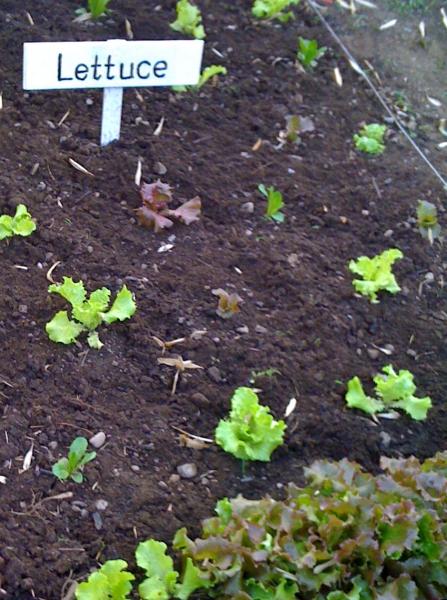
We’ve harvested all of the lettuce that we planted originally from seedlings.
The lettuce bed now contains seedlings we grew from seed, including those we transplanted from elsewhere in the bed so they would have enough room to really leaf out.
We also planted another set of seeds so we will be able to have 3 plantings of lettuce before it gets too hot, hopefully.
We get visitors
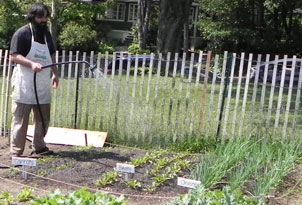
 Steven and I shared some time at the garden on a very hot Wednesday afternoon (May 24) but few families came by and they mostly wanted to enjoy the sprinkler and have water for their pails.
About 10 families came by Monday and Tuesday for short periods. One grandfather and small boy entered where the grandfather remarked his charge didn’t like veggies. But upon seeing the red of the radish the boy responded, “But I do like radishes!”
I was on hand Thursday and Friday from 2:30 to 4:30, more or less. On one, two 7-year-old girls walked all the paths as a maze. I showed them the new bean and squash seeds just coming up, and crushed a mint leaf for them to smell.
With a Chinese woman carrying a baby, I exchanged the names of the veggies in our respective languages, and also I gave her a mint leaf and a pea tendril.
Basil Progress
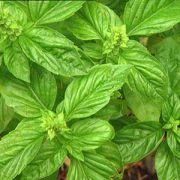
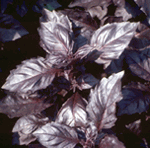 We planted two different kinds of basil on May 1st. We planted Green Lettuce Leaf basil, from Seeds of Change, and Sweet Petra Dark Red basil from Burpee. Both emerged about 10 days ago, although there are some fairly large holes in the rows of basil. This problem is probably due to the fact that not all seeds germinated.
We waited until May 1st to plant the basil, as basil likes warmer soil. The green lettuce leaf basil has the largest leaf of any basil and the sweet petra dark has a mild, sweet taste.
When the plants are about 2 or 3 inches tall it’ll be time to thin them to 4 to 6 inches apart. The leaves grow in pairs on either side of the basil. When there are 3 leaf pairs, it’s time to pinch the plant back right above a set of leaves. The best time to harvest is after the morning dew dries, but before the heat of the day.

It’s important to start harvesting the basil before the plants flower. Once you see flowers you should pinch them back to two sets of leaves below the flowers. The flowers release a hormone change within the plant that greatly reduces the flavor. Therefore, pruning regularly is important.
How many signs are too much? … How many, not enough? … In what contexts?
Pre Lady Bird Johnson

Post Lady Bird
2 prima donnas about to compete
We planted two varieties of eggplant this Saturday. One is Nadia, a zaftig, Rubenesque traditionalist from southern Europe. The other: Mangan, a darker, more svelte and modern variety from eastern Asia.
Both are beauties; and each has her fans. Both are also prima donnas. They abhor cold soil. So Nadia grew to seedling state in a greenhouse over at Waltham Fields, a few miles southwest of us, while Mangan got her start at Busa Farm, just over the town line in Lexington.
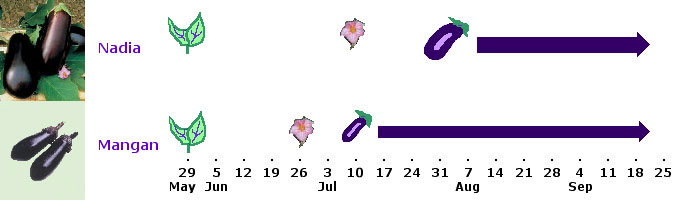
According to studies we found on the net, these two varieties should enjoy an interesting competition this growing season. Mangan is the speedy one. She should flower in as little as 4 weeks, then produce her first fruit 2 weeks after that. Nadia unfolds at a slower pace. She should lag Mangan by a couple of weeks in coming to full flower and another 3 weeks in bearing fruit.
But her fruit will be bigger, their shape more fetching to the eye. Pound for pound, Nadia should also end up producing more edible flesh per plant, though Mangan should best her in the number of individual fruits produced.
All in all, for those of us attending these two, this should be a lively competition to watch.
Sunflowers’ progress
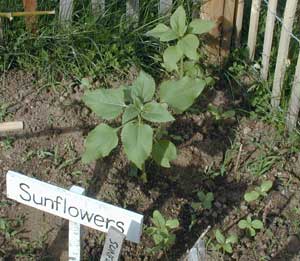 We planted sunflower seeds on April 24, Russian Mammoth from Seeds of Change. After waiting a few weeks, the germination looked weak, so I planted more seeds on May 14. Now in both sunflower patches, we have two big 5-week old plants, and a bunch of 2-week old seedlings. I think I’ll thin them down to two of each and see what happens.
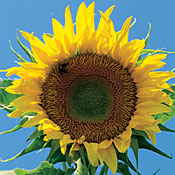 Time to bloom is around 110 days, so we can look forward to seeing them in bloom around mid-August.
Sunflowers made the cut in our "all vegetable" garden because the seeds are, after all, edible and delicious. More than likely though, the birds will get them all. No problem – birds eat the bad bugs, too. We like birds.
